Arteve

Designing a platform to help musicians find gigs and manage their careers

Role: Product Designer
Timeline: 2024 – Present
Scope: End-to-end product design (discovery, booking, messaging)


The Problem

Independent musicians don’t struggle because of a lack of talent — they struggle because of a lack of structure.

Most rely on a mix of Instagram, word-of-mouth, and fragmented platforms to find gigs. This leads to inconsistent opportunities, missed connections, and a constant need for self-promotion.

At the same time, event organizers and clients face the opposite problem. Finding reliable musicians is time-consuming, unpredictable, and often based on incomplete information or referrals.

There is no single place where:

  • Musicians can consistently discover opportunities
  • Organizers can confidently find and evaluate talent
  • Both sides can manage bookings and communication efficiently

As a result, both sides operate in a system that is:

  • Fragmented
  • Manual
  • Unreliable

Why this matters

For musicians, this directly impacts their ability to build a sustainable career.
For organizers, it affects the quality and reliability of their events.

This isn’t just a discovery problem — it’s a coordination problem across an entire ecosystem.


Why I worked on this

While exploring the creative ecosystem, I noticed a recurring pattern:

Talented artists were spending more time looking for opportunities than actually practicing or performing.

This wasn’t a skill issue — it was a system design issue.

Arteve started as an attempt to rethink how opportunities, visibility, and bookings could exist within a single, structured platform.


Research & Key Insights

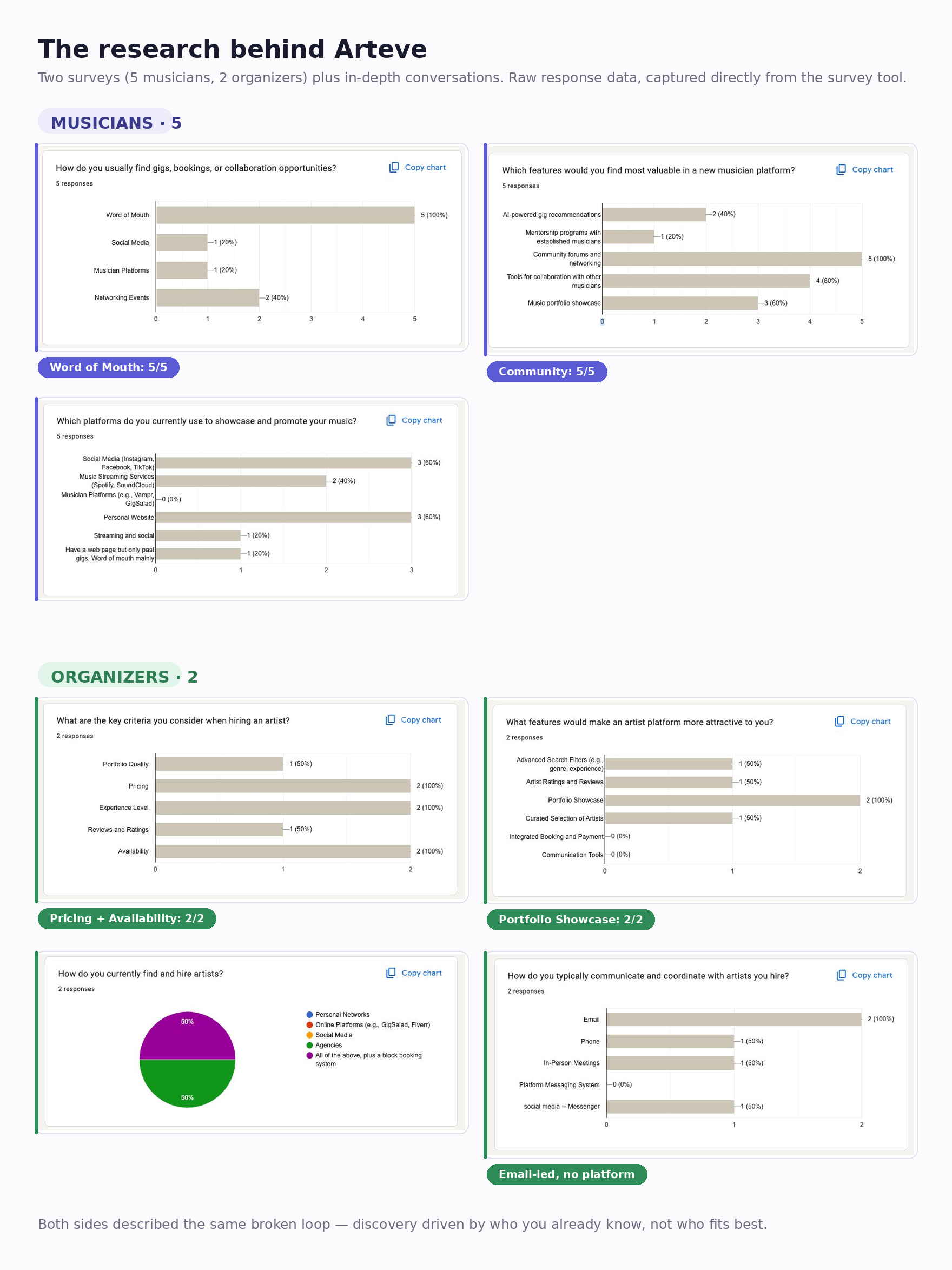
To understand the problem space, I explored the workflows of three primary user groups:

  • Professional musicians
  • Emerging artists
  • Event organizers

Instead of focusing on surface-level behaviors, I looked at how these users actually discover opportunities, communicate, and manage bookings in real-world scenarios.


Insight 1: Discovery is fragmented and unreliable

Musicians rely heavily on:

  • Instagram
  • Word-of-mouth
  • Personal networks

Opportunities are often hidden, inconsistent, and dependent on who you know rather than what you offer.

For emerging artists, this creates a significant barrier to entry.
For professionals, it leads to inconsistent income and constant outreach effort.


Insight 2: Self-promotion is time-consuming and inefficient

Musicians spend a large portion of their time:

  • Promoting themselves
  • Reaching out to organizers
  • Maintaining multiple platforms
This shifts focus away from their actual craft. The more time they spend finding gigs, the less time they spend improving their work.

Insight 3: Organizers lack trust and efficient filtering

Event organizers face the opposite challenge:

  • Too many options with little verification
  • No structured way to evaluate talent
  • Heavy reliance on referrals

This makes hiring:

  • Risky
  • Time-consuming
  • Inconsistent in quality

Insight 4: Booking and communication are disconnected

Even after discovery, the process is still fragmented:

  • Conversations happen across DMs, emails, and calls
  • Contracts and expectations are unclear
  • Scheduling is manual

This leads to:

  • Miscommunication
  • Missed opportunities
  • Operational friction

Insight 5: There is no system for long-term career growth

Existing platforms either focus on:

  • Networking (like social platforms)
    OR
  • One-time gigs (like booking marketplaces)

There is no unified system that supports:

  • Discovery
  • Booking
  • Communication
  • Career growth

Defining the problem

Based on these insights, the core problem became clear: How might we create a structured system that enables musicians to consistently discover opportunities, while allowing organizers to efficiently find and book reliable talent?

Solution

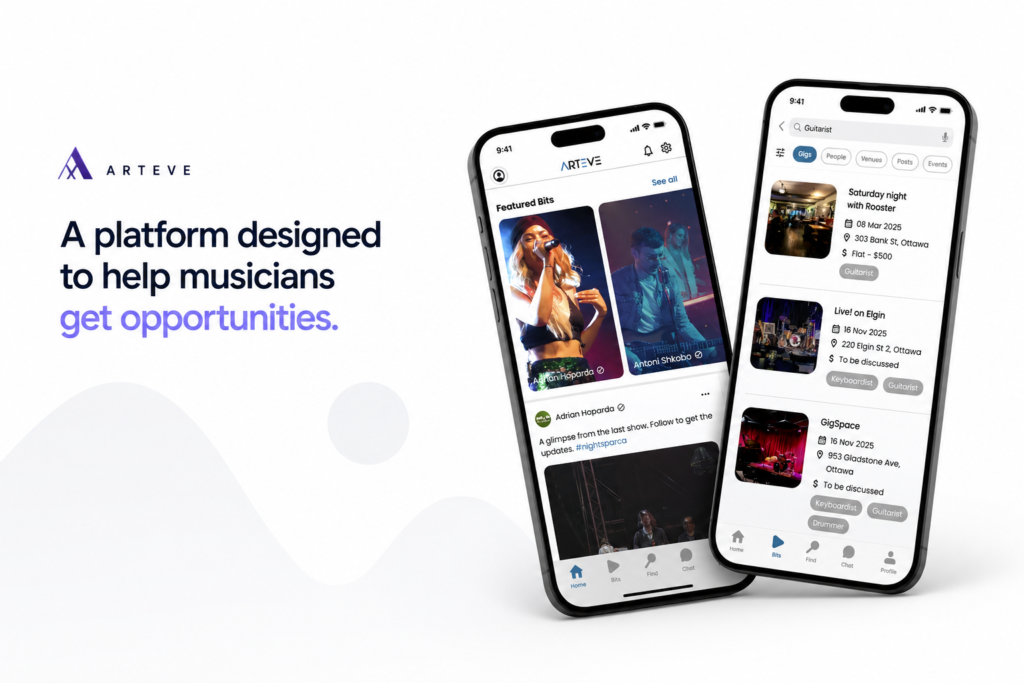
Arteve is a LinkedIn-style platform for musicians — designed not just for networking, but for discovering opportunities, managing bookings, and building sustainable careers.

Instead of separating discovery, communication, and execution across different tools, Arteve brings everything into a single structured system.

The goal was not to create another social platform, but to design a product that supports the entire journey from discovery to booking.


Product Strategy

Based on the research insights, the platform was designed around three core principles:


1. Structured discovery over passive networking

Instead of relying on feeds or random connections, Arteve introduces a more intentional discovery system:

  • Musicians can showcase their work through structured profiles
  • Organizers can search and filter based on specific needs
  • Opportunities are visible and actionable

This shifts discovery from:

  • Passive scrolling
    → to
  • Goal-driven exploration

2. Reduce friction in booking and communication

To address fragmented workflows, Arteve integrates:

  • Direct messaging between musicians and organizers
  • Clear booking flows
  • Centralized communication

This removes the need for:

  • Switching between platforms
  • Managing conversations across different channels

3. Support long-term career growth, not just one-time gigs

Unlike traditional gig platforms, Arteve is designed to support:

  • Ongoing visibility
  • Repeat opportunities
  • Professional identity

Musicians are not just profiles — they are evolving professionals within a system that tracks and supports their growth.


High-level experience

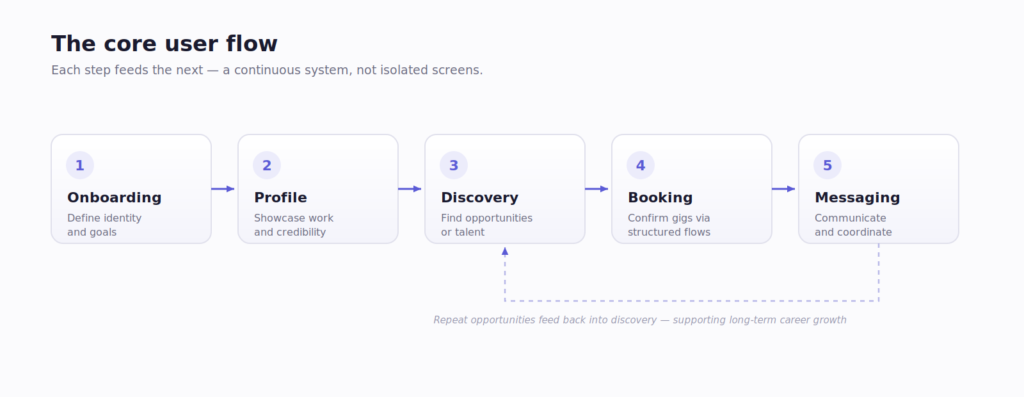
The product experience was designed as a connected flow:

  1. Onboarding → Define identity and goals
  2. Profile → Showcase work and credibility
  3. Discovery → Find opportunities or talent
  4. Booking → Confirm gigs through structured flows
  5. Messaging → Communicate and coordinate seamlessly

Each step feeds into the next, creating a continuous system rather than isolated interactions.


Key Features & Design Decisions

To translate the product strategy into a working system, I focused on designing and implementing key workflows that connect discovery, communication, and booking.


1. Profiles — Establishing credibility and identity
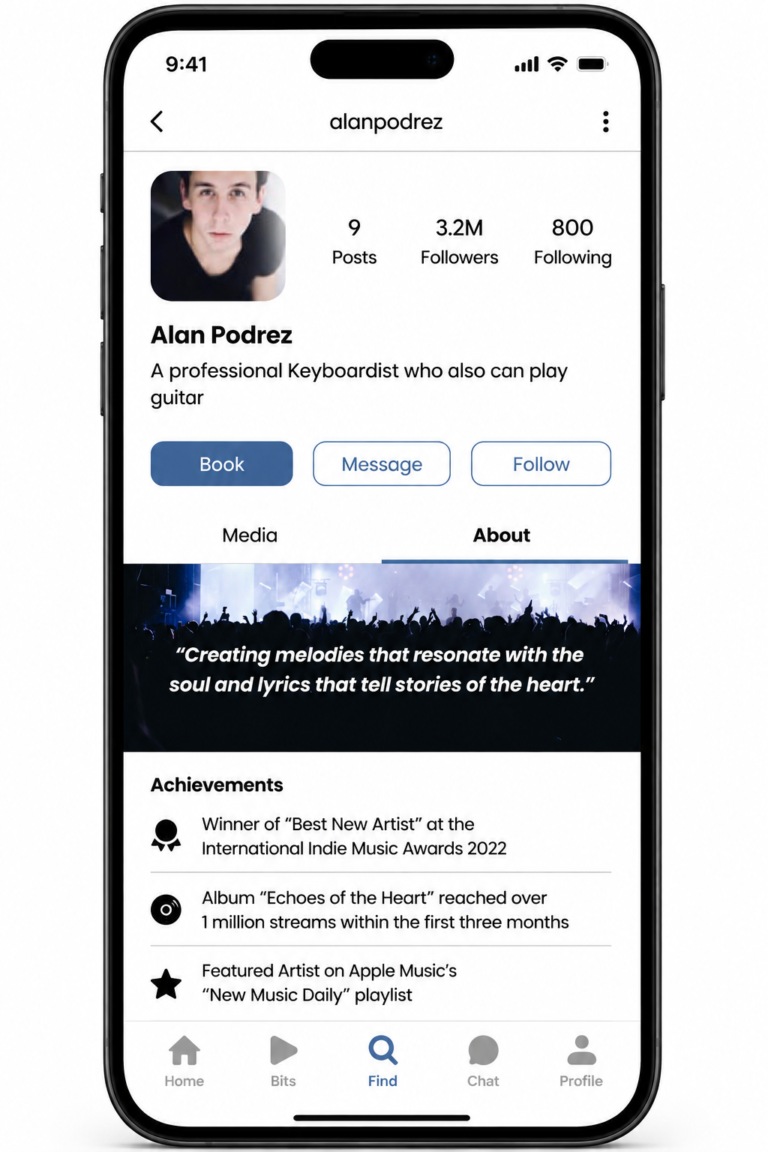
One of the biggest challenges for both musicians and organizers was trust.

Musicians needed a way to:

  • Showcase their work
  • Communicate their style and experience
  • Build a professional presence

Organizers needed a way to:

  • Quickly evaluate talent
  • Compare options
  • Make confident decisions

To address this, I designed structured profile pages that:

  • Highlight key information (genre, experience, media)
  • Provide a clear overview of the artist
  • Support decision-making without requiring external links

This transforms profiles from:

  • Static social pages
    → into
  • Decision-making tools

2. Discovery (Find Page) — Moving beyond passive browsing
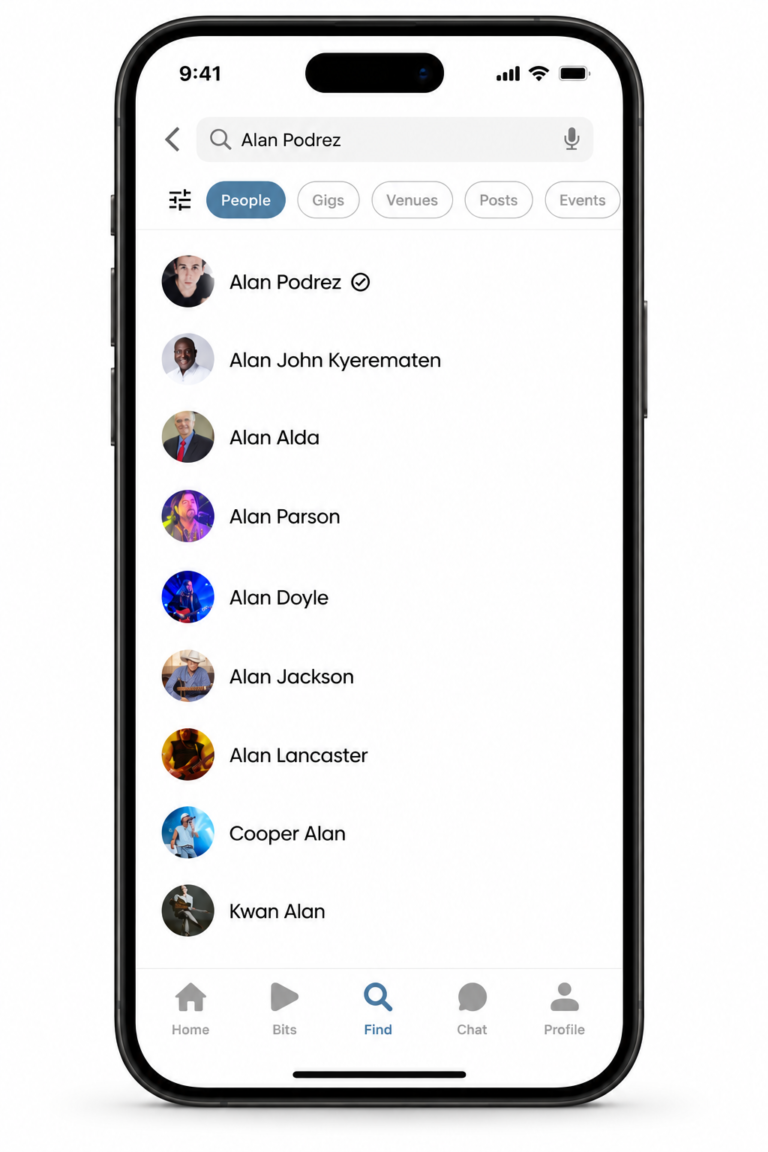
Traditional platforms rely heavily on:

  • Feeds
  • Random discovery
  • Social reach

Instead, I designed a goal-driven discovery experience:

  • Users can actively search for:
    • Musicians
    • Gigs
  • Filters allow narrowing results based on needs
  • Results are structured and scannable

This reduces:

  • Time spent searching
  • Dependence on algorithms

And increases:

  • Relevance
  • Intentional decision-making

3. Gig Creation (Organizer Flow) — Structuring opportunities
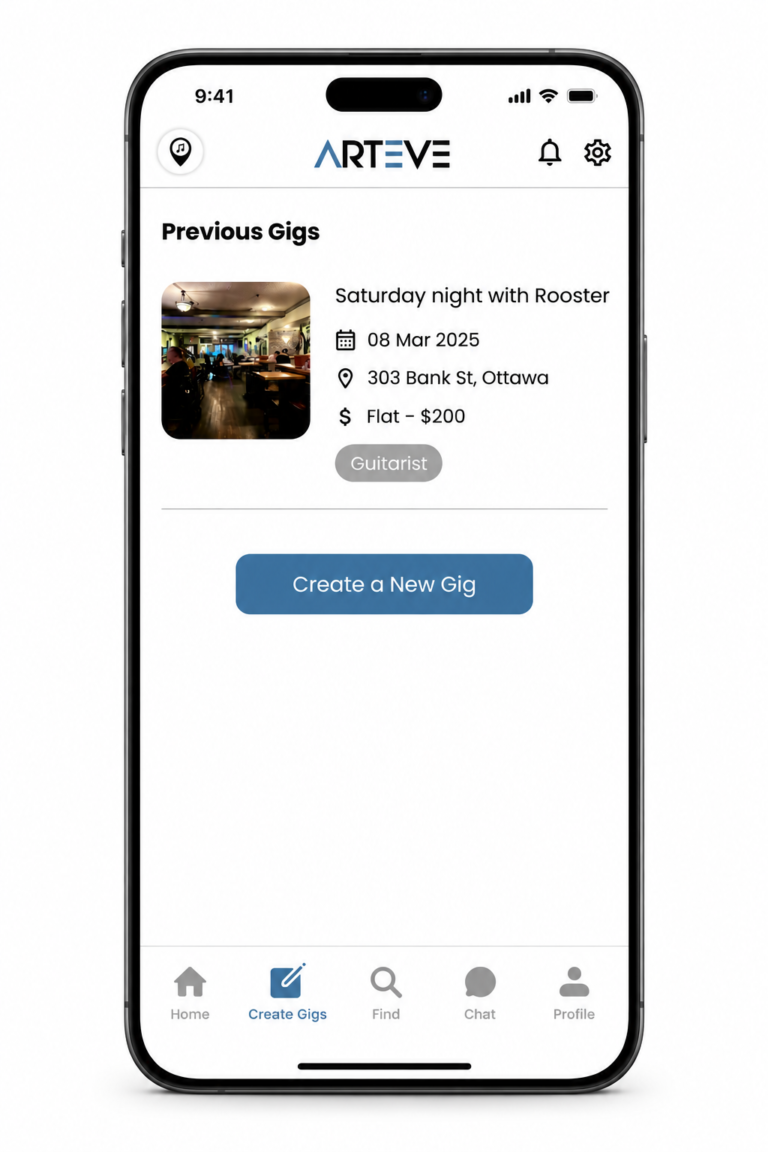
For organizers, posting opportunities is often:

  • Informal
  • Incomplete
  • Scattered across platforms

I designed a structured gig creation flow that:

  • Captures essential details (event type, budget, requirements)
  • Standardizes how opportunities are presented
  • Makes gigs easier to discover and evaluate

This improves:

  • Clarity for musicians
  • Efficiency for organizers

4. Messaging (Chat System) — Centralizing communication
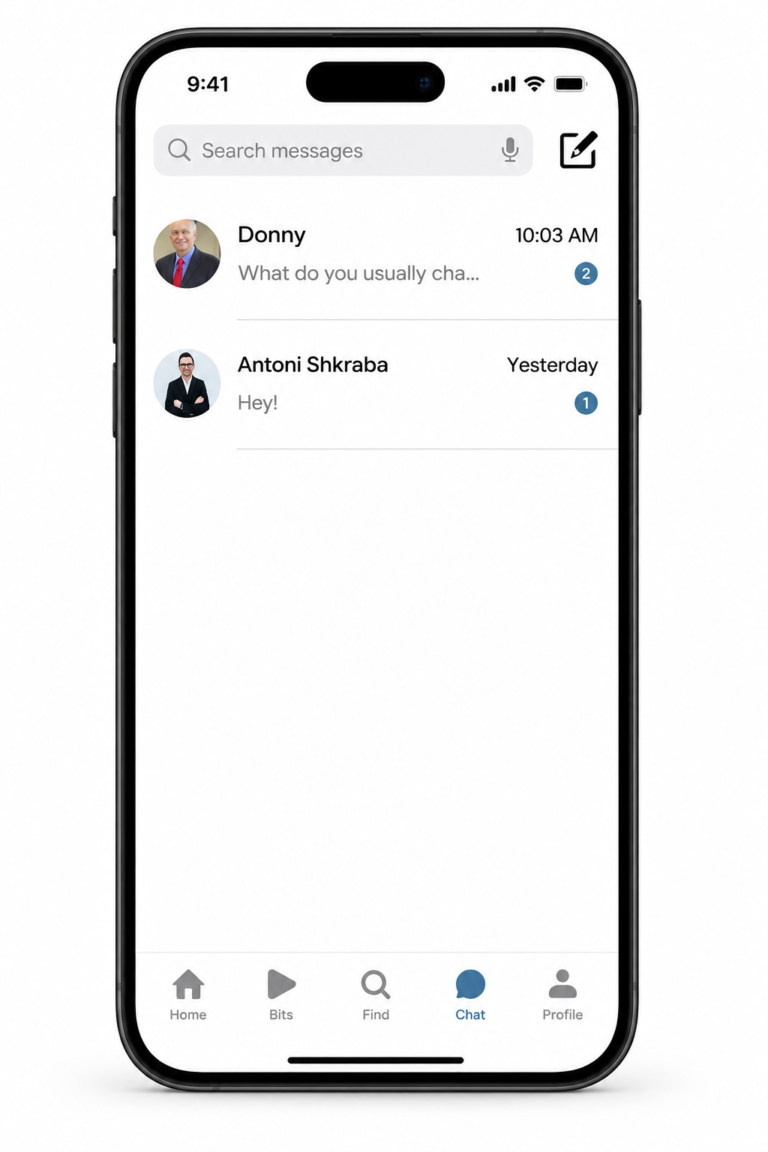
One of the biggest friction points was communication happening across multiple channels.

To solve this, I designed and implemented a centralized messaging system:

  • Direct conversations between musicians and organizers
  • Contextual communication tied to bookings or opportunities
  • Reduced reliance on external tools (Instagram, email, etc.)

This creates:

  • A single source of truth
  • Better coordination
  • Fewer missed details

5. Home & Content Layer (Bits) — Supporting visibility
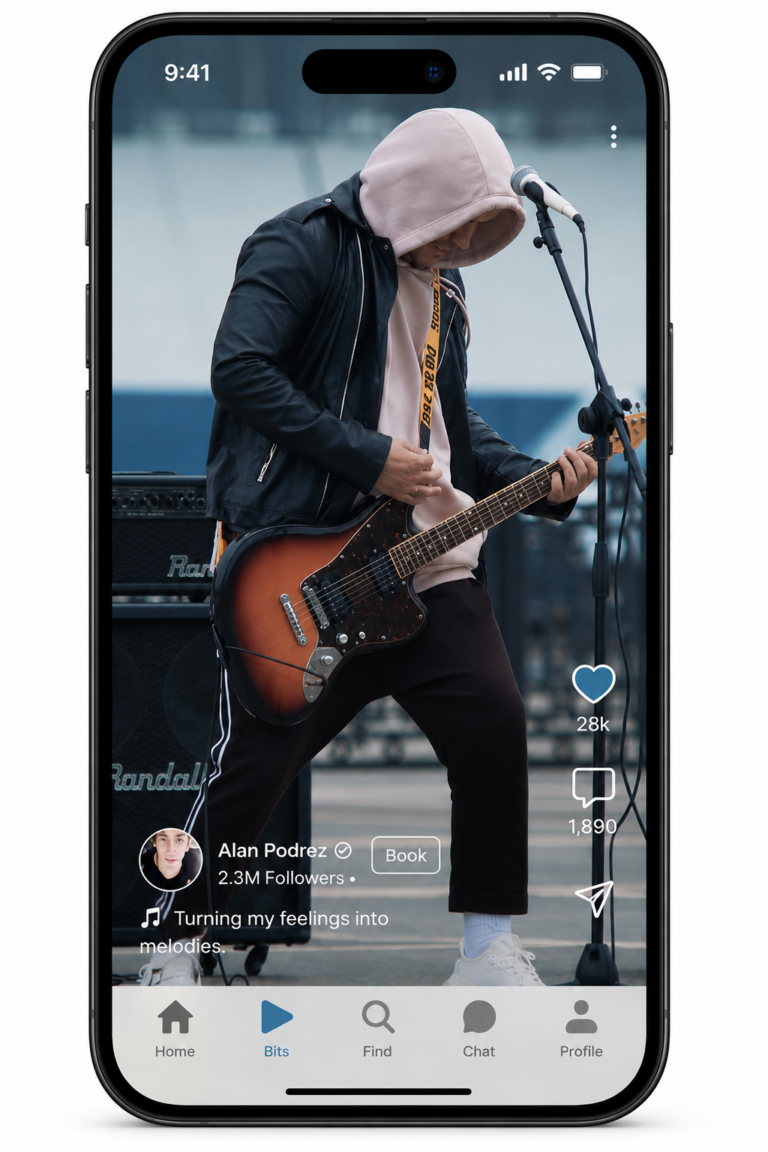
Beyond direct discovery, musicians still need visibility.

I introduced a lightweight content layer (“Bits”) where users can:

  • Share updates
  • Showcase work
  • Stay visible within the platform

Unlike traditional social feeds, this is designed to:

  • Support professional visibility
  • Complement discovery, not replace it

From Design to Implementation

Beyond designing these flows in Figma, I also worked on implementing key parts of the product using modern tools.

This allowed me to:

  • Validate design decisions in a real environment
  • Identify edge cases and usability gaps
  • Iterate faster based on actual product behavior

This shift from static design to working product helped refine:

  • Interaction patterns
  • Navigation structure
  • Real-world usability

Iterations & Key Learnings

Designing Arteve wasn’t a linear process. One of the biggest shifts came from rethinking the core structure of the platform itself.


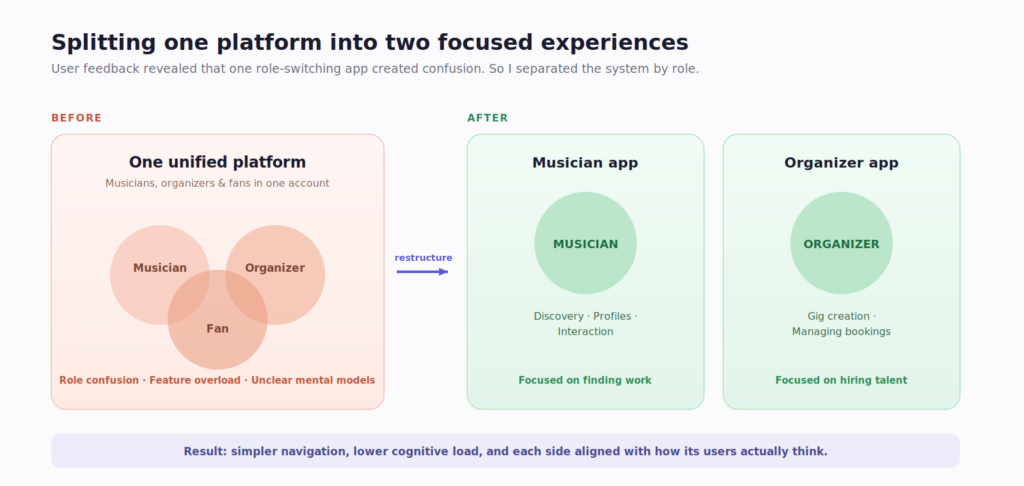
Initial Approach — One unified platform

The original idea was to build a single platform where:

  • Musicians
  • Organizers
  • Fans

could all exist and interact within the same system.

Users could switch roles within the same account, allowing flexibility between being a musician, organizer, or general user.


What didn’t work

As the product evolved, this approach introduced several challenges:

  • Role confusion
    Users were unclear about their identity within the platform, especially when switching between musician and organizer roles.
  • Feature overload
    Combining all user types into one experience made the interface feel cluttered and less intuitive.
  • Unclear mental models
    Musicians found features like “Create Gig” confusing when they didn’t identify as organizers.

User feedback

When I spoke with musicians, a few patterns became clear:

  • They wanted a clear, focused experience based on their role
  • They did not naturally think of themselves as “organizers”
  • They expected workflows to match their real-world behavior
Another key insight: Many bands are managed by a single individual who is not necessarily a performing musician.

This revealed a gap in the system:

  • The platform needed to support group identities, not just individuals
  • Similar to how companies exist alongside individuals on LinkedIn

Iteration — Splitting the system

Based on these insights, I restructured the product into separate experiences:

  • A musician-focused app for discovery, profiles, and interaction
  • An organizer-focused app for creating gigs and managing bookings

This change:

  • Simplified navigation
  • Reduced cognitive load
  • Made each experience more intentional

Impact of the change

After restructuring:

  • Features became easier to understand
  • Navigation aligned better with user expectations
  • The product felt more focused and purpose-driven

Although I haven’t yet conducted a full round of testing after this change, this iteration significantly improved the clarity of the system.


Key Learning

Designing for multiple user roles isn’t just about adding features — it’s about designing clear boundaries and mental models.

This project reinforced the importance of:

  • Aligning product structure with real-world behaviors
  • Reducing ambiguity in multi-sided platforms
  • Iterating not just on UI, but on product architecture itself

Impact & Validation

Arteve was recognized beyond just a design project.

The product won the Activate Pitch Championship and secured initial funding support from Invest Ottawa, validating both the problem space and the proposed solution.

This was an important milestone — not just as recognition, but as confirmation that the platform addresses a real gap in the creative ecosystem.

More importantly, early conversations with musicians reinforced the core direction:
Arteve is not just another social platform — it’s a system designed to support how artists actually find work and manage their careers.


What’s next

The product is still evolving.

To take Arteve further, the next step is scaling it into a full production-ready platform:

  • Expanding development beyond MVP-level features
  • Rolling out to a broader user base
  • Collecting real behavioral data to guide future iterations

This will allow the product to move from:

  • Insight-driven design
    → to
  • Data-informed product decisions

Key learnings

One of the biggest lessons from this project was how often initial assumptions break down.

Early ideas based on secondary research felt logical — but once I spoke directly with users and observed real workflows, gaps became obvious.

User feedback didn’t just improve the product — it changed its direction entirely.

At one point, this meant rethinking the core structure of the platform and starting over from a different perspective.

Designing for real users requires letting go of assumptions — even when it means rebuilding from scratch.

Reflection

This project shifted how I approach product design.

I moved from:

  • Designing features
    → to
  • Designing systems

And from:

  • Validating ideas visually
    → to
  • Validating them through real user behavior

Arteve reinforced that good design is not about getting it right the first time —
it’s about continuously aligning the product with how people actually think, work, and make decisions.